Showing posts with label collective memory. Show all posts

Thursday, September 22, 2011

Utopia Sound: Todd Rundgren's Woodstock

Awhile back, I argued that Woodstock—at once a place, a culture/nostalgia industry, and a sensibility—exerts a tremendous hold on geographical self-imaginary of the surrounding Hudson River Valley in which it's located (and where I live).  To pry back the myth of Woodstock a bit, I'll occasionally share some historical research on Woodstock's musical geography.  In this post, I'll start with the milieu of recording studios and music industry associated with Todd Rundgren, who worked and lived part-time to full-time in Woodstock from 1969 to the late 1980s. 


It's conceivable that some readers today are unfamiliar with Todd Rundgren, who doesn't seem to generate much interest these days beyond music gearheads, 70s diehards, and his rabid devotees.  That's too bad.  Among other things he blazed the trail for your Princes, your Becks, and all the other iconoclastic solo artists who insisted on playing all their own instruments and recording eccentric, often mindblowing yet emotionally deep albums... and double albums, live albums, video albums, albums that listeners could remix themselves, subscription-based albums...  Perhaps just as important is his work as a record producer for artists such as the New York Dolls, Meat Loaf, Patti Smith, Grand Funk Railroad, XTC, the Psychedelic Furs, Sparks, the Tubes, and Cheap Trick.

Significantly, Rundgren's greatest artistic and commercial achievements as a recording artist and record producer (through the 1970s and 80s) coincides with his ubiquity all over the Woodstock map.  They also appear after the three events—Bob Dylan's 1966 motorcycle accident, the 1968 release of the Band's debut album Music from Big Pink, and the 1969 Woodstock Music Festival—for which Woodstock remains most associated in pop culture.  So examining the house that Rundgren built (not just a metaphor, as we'll see) offers a glance at a Woodstock that's less iconic in rock culture, and maybe a little more local.  Not that it's necessarily 'more real'; Rundgren generated his own local mythology during his Woodstock years, much of which still affects the way Woodstock musicians and boosters think of the place.

My research here draws primarily from Paul Myers' book, A Wizard A True Star: Todd Rundgren in the Studio (Jawbone, 2010), which focuses specifically on Rundgren's work as a record producer on other people's albums as well as his own.  I've tried to find out what became of the Woodstock studios and landmarks that Myers examines based on some simple Google and Wikipedia searches, plus what I've learned as someone who lives 30 minutes away from Woodstock.  No doubt I've gotten a few details wrong.  If anyone out there can share more accurate information or fill in the blanks, please share your knowledge in the comments section below.


Bearsville Studios
A Philadelphia native, Rundgren first came to Woodstock in 1969 to work at Bearsville Studios, the recording facility built and owned by Albert Grossman.  A legendary artist manager in folk and rock music, Grossman is responsible for advancing the careers of Bob Dylan (he's prominently depicted in the Dylan documentary "Dont Look Back"), Janis Joplin, the Band, Peter John Lee Hooker, and Peter, Paul and Mary, among many others, at key points in their careers.  Notorious for the 25% fee he charged his clients (15% was traditional for managers), he also fiercely defended their careers and promoted their art in an often uncomprehending, out-of-touch music industry, and Bearsville Studios was an important part of his arsenal.  Headquartered in the rustic hamlet of Bearsville (part of the Town of Woodstock), the facility offered Grossman's clients and other recording artists high-end recording technology and a staff who understood the rock and roll lifestyle, all at an easy two-hour drive from New York City.

Todd Rundgren was hired Bearsville Studios' staff producer and engineer.  Something I never actually knew before Myers' book was that following the 1969 break-up his psychedelic garage rock group Nazz, Rundgren didn't foresee a recording career for himself anymore. "'When I first became a record producer,' says Rudngren, I thought, 'That's it, I'm done performing'" (pg. 35).  Despite early misgivings from Grossman, Rundgren quickly established himself as Bearsville's "boy wonder," as Grossman's wife Sally called him. "'To be such a renaissance man as he was at the age of 21,' [Sally] Grossman said, 'was very striking.  We were spoiled, of course, but we were so used to brilliant people... but he was like all of them, his talent was already full-blown'" (pg. 40).

Albums that Rundgren produced at Bearsville Studios includes Meat Loaf's Bat Out of Hell (1979) and the Patti Smith Group's Wave (1979).  Distinctively, the facility offered clients on-site residences where they could stay during their recording work.  Alongside adjacent facilities constructed later (including Rundgren's Utopia Video Studios, described later), the Bearsville Studios property was subsequently reconfigured, subdivided and sold off by Grossman's widow.  Its theater soundstage is now the home of the Bearsville Theater, one of the Hudson River Valley's premiere smaller concert venues.


Woodstock Playhouse
Rundgren's reputation as a studio wunderkind began to circulate after he worked with Grossman's clients The Band, whose third album Stage Fright (1970) he engineered in the local Woodstock Playhouse theater.  The Band's original plans for the album sheds an interesting light on how Woodstock community responded to the famous rock festival.

According to [guitarist Robbie] Robertson, The Band had initially intended to record Stage Fright, their third album, in the form of a free concert staged at the Woodstock Playhouse for the local townspeople, whom they felt had been unduly disturbed during the previous summer's Woodstock Music & Arts Festival in nearby Bethel, New York.  The town still harbored lingering resentment toward the rock musicians and hippies who had disturbed their formerly quiet artists' enclave, however.  "We'd felt really bad about it," laughs Robertson, "so, as a gesture, we thought we could just rehearse some new material and put on this private concert for the townspeople.  The town council said 'Thanks, but no thanks.'  I think they thought that the show would just attract more Volkswagen buses like the year before" (pg. 36).

Rundgren attempted to mix Stage Fright back at Bearsville Studios, but The Band's dissatisfaction led them to pick British producer Glyn Johns to do the final mix.  Also of note, at this recording session Rundgren met Patti Smith, then a young unknown poet who was visiting the session with songwriter and Dylan associate Bob Neuwirth.  Today, the Woodstock Playhouse still functions as a community theater.


Bearsville Records
After the studio came Grossman's record label, Bearsville Records, in 1970.  It signed some of his less famous clients (Paul Butterfield, Jesse Winchester) but also other artists not under Grossman's management (Foghat, the first incarnation of Sparks).  Ultimately, Bearsville's most famous recording artist was Rundgren himself, whose extracurricular activities recording "little ditties" during the studio downtime of the artists he produced kindled an interest in making albums of his own.   In this way, Grossman's relationship to Rundgren expanded from employer to artist manager.

"I don't think Albert kept that kind of distinction between star producer and star artist client," says Rundgren.  "I was always problematic that way and it probably would have been worse for a different kind of manager than Albert, who was used to dealing with people who could be very self-directed, temperamental, or mercurial, like The Band, Bob Dylan, and Janis Joplin.  And I wasn't concerned with satisfying record company demands.  My attitude was, just make the record you make and then hope that the label can find a way to promote it.  In fact," he laughs, "I kind of expected the label to eat the loss!" (pg. 41).

Far from it—with his third record, the double album Something/Anything? (1972), and its breakthrough single, the soft-rock nugget "Hello It's Me," Rundgren became a massive selling solo recording artist.  Several years of media celebrity, famous girlfriends, and critical acclaim followed.

Grossman was never the easiest of label bosses to deal with; his indifference to Rundgren's group Utopia, who recorded some dozen studio albums between 1974 and 1985, was an especially sore spot with Rundren.  By 1975 his day-to-day management was transferred to others in the Grossman Organization, and Rundgren reached the last straw in 1984, during the recording of his 12th solo album A Capella.  Rundgren recalls:

We were at the end of a contractual period and Albert could never stand the idea of you going forward without him getting a piece of you somehow.  He wasn't managing me anymore and I was looking to move on from the label, and he just became completely unscrupulous with me.  He held up A Capella up for about a year until I agreed to give him publishing on my next three records.  In exchange for letting me go do a three-record deal at Warner Bros, Albert retained the publishing on those albums.  At least, this way, it was allowed to come out at all (pg. 249).

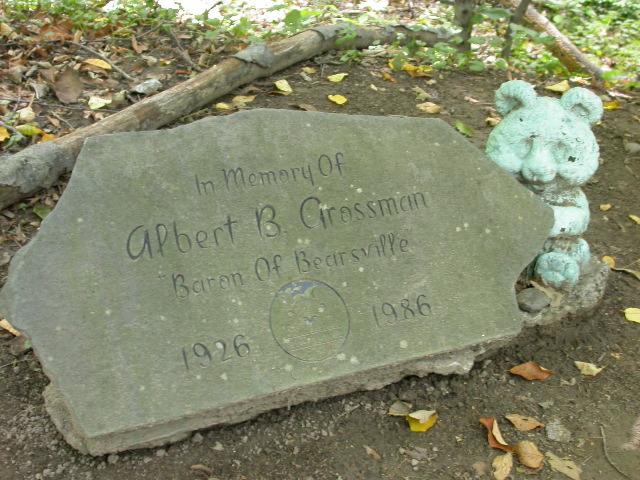
Unexpectedly, Grossman died of a heart attack on a Concorde jet in 1986.  He was buried behind Bearsville Theater.  His label had folded two years prior, in 1984; today, its catalogue is distributed by Rhino Records.


Utopia Sound
Interestingly, Rundgren never recorded his own albums primarily at Bearsville Studios, despite his familiarity with the facility.  He made his first three albums in Los Angeles; the first three sides of Something/Anything? were recorded in his Nichols Canyon house, as captured in the gatefold sleeve photo, while the ensembles captured on side four (e.g., "Hello It's Me") were ecorded at NYC's Record Plant.  Next, Rundgren set up his own studio out of keyboardist Moogy Klingmann's Manhattan loft on 24th & 8th: Secret Sound, where Rundgren recorded his psychedelic double-albums A Wizard A True Star (1973) and Todd (1974) and the first Utopia record (1974).  Myers indicates that the most Rundgren ever recorded at Bearsville Studios was for parts of his sixth solo album, Initiation (1975), including the 36-minute prog/fusion epic "A Treatise On Cosmic Fire" (all crammed on one side of an LP!). 


Over the following ten years, Rundgren shifted much of his recording activity (solo and with Utopia) and production work, as well as his personal life, into a house and studio on Mink Hollow Road in the Lake Hill section of Woodstock.

            Heading into the summer of 1975, Rundgren's growing disdain for the social demands of New York City life had resulted in he and [then girlfriend Bebe] Buell leaving their three-story Manhattan brownstone for a woodland sanctuary in upstate New York.  After his relationship with Albert Grossman had cooled somewhat, Rundgren's day-to-day management was now being handled by Susan Lee at the Grossman Organization, who advised him that it would be wise to reinvest a portion of his prodigious production income into real estate.  And what better place to build his next home and studio, Rundgren thought, than the Woodstock area, where it had all began?
            "It was funny," says Rundgren, "at one point, I had so much money that I pretty much had to buy a house.  It was stupid to have all this money and not invest it in something.  So that's when I bought the house on Mink Hollow Road in Lake Hill, New York."
            Recalling the history of the Mink Hollow Road location, high up in the woods, near the foot of the Catskill Mountains, [Utopia keyboardist] Roger Powell says, "The property had originally been purchased by this architect, who was going to build a big house on it.  But the first thing he did was build this little wooden A-frame house, so that he had a place to live while he was building a fancier house, a little further up the hill.  When Todd bought the property, he moved into the fancier house and eventually converted the smaller wood house into his studio" (pp. 131-2).


In 1976, Rundgren bought the neighboring house turned it into a guest residence.  Following the model of Bearsville Studios, he could now offer Utopia Sound clients housing as well as recording with unrestricted studio hours, rolling the final costs into a larger production advance for himself.  "[D]epending on how efficiently the recording process went"—and Rundgren was famous for demanding extensive rehearsals and composition before his clients entered the studios—most recording artists could save money while Rundgren got the convenience of working out of his home. 

Utopia Sound became the base of recording and rehearsals for Todd's solo albums and the albums of by the band of the same name.  (Utopia is a recurring brand for Rundgren, as we'll see.)  Albums he produced there included the Psychedelic Furs' Forever Now (1982), Cheap Trick's Next Position Please (1983), and XTC's Skylarking (1986, a famously troubled session). On the liner notes for Forever Now, the Furs thanked "the man on the stairs"—a reference to the location of Utopia Sound's control room in an upstairs loft, which required Rundgren to descend a ladder staircase to talk to the musicians.

The Mink Hollow residence was a site of personal trauma and emotional development for Rundgren.  The title of his eighth solo album, 1978's Hermit of Mink Hollow (which saw a return to singer-songwriter form with the single "Can We Still Be Friends?") suggests his lifestyle after Bebe Buell left him with a child in toe (baby Liv Tyler) that Rundgren was attached to, despite the fact that he wasn't the father.  His next girlfriend moved into Mink Hollow and, in 1980, was pregnant with their first child when four armed thieves committed a home invasion.  "It was a horrifying violation and it started to make us feel kinda creepy about living up there.  We never had a similar episode, but apparently there had been a wave of related criminal events in the Woodstock area, so were [sic] just 'lucky,' I guess, to be part of that particular spree" (pg. 208). 

By the late 1980s, Rundgren moved to the Bay Area, where he increasingly became involved with Silicon Valley's hacker/entrepreneurial community.  By 1996, he stopped working at Utopia Sound altogether; having shifted almost entirely to recording his own music on a laptop computer, he no longer felt it necessary to have a personal studio at his disposal.  I'm not sure who owns the property today, but evidently it's no longer a recording studio


Utopia Video Studios
As early as 1974, Rundgren was excited by the artistic promise of music video and eager to try his hand at video production work; predictably, he sought to develop a video production facility that would give him greater control and unrestricted studio time.  By 1977, Rundgren began diverting the considerable income he had earned from producing hit albums for Meat Loaf and Grand Funk Railroad into this new venture.  Initially he worked on setting up a facility within Bearsville Studios, sometimes while producing artists at the same time, as Jay Dee Daugherty of the Patti Smith Group recalls:

On some tracks, we would just start recording and he'd wave through the glass and leave to work in his video studio for a while.  Then, he'd pop back in, later, to see how it was going and, at crucial moments, he'd shepherd us through the process.  It was an interesting combination of "hands on" and "hands off" and everybody was really comfortable with that" (pg. 191). 

Eventually, Rundgren relocated the project to an adjacent 2,500 square foot facility, Utopia Video Studios, which opened in 1979.  He shot a number of videos here including 1981's "Time Heals," the second video MTV ever showed, right after the Buggles' "Video Killed The Radio Star."  However, the scale and expenses of the facility and its staff soon became too burdensome; at its height employing a staff of 10-20 personnel, it cost $40,000 to 50,000 just to keep open.  Discovering that he was taking work on that he wasn't excited about just to keep the facility afloat, he finally gave up on Utopia Video Studios in 1983.

Presently, the facility is in operation as Utopia Soundstage.  Since 1999, Woodstock's independent radio station, WDST, has shared the building as a base for its on-air studio and offices.


Woodstock village
Myers doesn't report much about how often and where Rundgren would drive into the village from his Mink Hollow residence.  What's clear, however, is that his recording clients invariably made their way down and their presence known.  The Psychedelic Furs' Tim Butler recalls their local haunts:

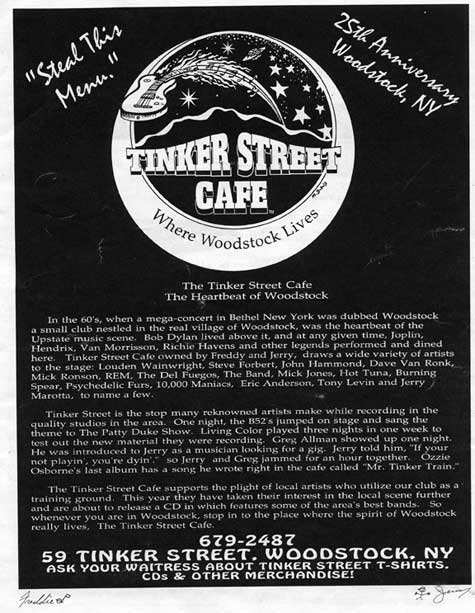
we used to go down into the town of Woodstock and sort of carouse around, getting drunk and stuff.  You'd drive into town and there'd be all sorts of head shops and bead stores, even though the actual Woodstock festival had been miles down the road, in Bethel.  We used to drink down at the Tinker Street Café, and I seem to remember they had a guitar up on a shelf that was meant to be Bob Dylan's (pg. 221).

Cheap Trick remembers their Woodstock experience:

"Oh yeah, adds, [Bun E.] Carlos, "We were up on Cripple Creek there, in the Catskills, in that crappy little dumpy old farmhouse then we'd go up the hill and record at Todd's tiny A-frame studio."
            Sometimes, [Rick] Nielsen admits, cabin fever would set in.  The band spent a few evenings in the town of Woodstock, "getting into trouble and hanging out with all the locals" at the Little Bear or the Big Bear (pg. 234).

These passages are hardly conclusive evidence, but they suggest that the attitude of "the locals" to rockstars and Woodstock's musical legacy had turned around considerably since the days when the town council passed on The Band's offer of a private concert.  Of course, in the intervening 15 years it's likely that there was considerable turnover in the local population.  The plethora of local recording studios that appeared in the wake of Bearsville Studios and Utopia Sound underscores how Rundgren's years were key ones for the development of Woodstock as place, industry, and cultural sensibility.

Thursday, September 8, 2011

why I'm not listening to music to commemorate 9/11

Three days from now, many of us will spend some time remembering where we were and what we were doing on that day ten years earlier.  I remember learning that two planes had crashed into New York City's World Trade Center at a morning department meeting, then passing on the news to my 10:30 am sociology class.  On a residential college where 10:30 am is an "early class," and before there were iPhones, Facebook and Twitter, few of my students heard the awful news from another source before I broke it to them; it's with a heavy heart that I realize mine is a face they'll associate with that "where I was" memory.

But in case you're having difficulty remembering that day, it's fairly easy to find a steady media stream of news specials and opinion segments commemorating the tenth anniversary of 9/11.  On most of these we'll see Ground Zero before and after 9/11; be reminded how promisingly warm and sunny that late summer day was; review the iconic plane crashes into the twin towers from several vantage points (the moments of impact at the Pentagon and Shanksville, PA were never filmed); watch once again as the towers burn, collapse, and spew their cloud of smoke across downtown Manhattan; and see the faces of NYC residents, emergency crews, workers and visitors twist with horror, grief, and confusion at the unfathomability of the event they're living through.

And then of course we'll be treated to the subsequent events that provided the dominant definition of 9/11: the lengthy digging out and search for casualties at Ground Zero; the international outpouring of grief and sympathy; the response of Mayor Giuliani, President Bush, Secretary of Defense Rumsfeld  et al; the introduction of "al Qaeda" and "axis of evil" into mainstream news vocabulary; the War on Terror in Afghanistan; the War on Terror in Iraq; Guantanamo Bay; Bush's 2004 re-election; and on and on into the present day of routine anxiety and war without end. 

But the events that occurred on the specific date of September 11, 2001 are of such magnitude, they deserve to be isolated from their subsequent redefinitions into (what my Dunkin Donuts calendar reminds me is) "Patriot Day" in the U.S.  That date should be remembered in its original incomprehensibility.  And it certainly doesn't need the musical soundtrack that the news specials will invariably give it—no mournful wordless vocal of a wailing woman (a la Dead Can Dance or Peter Gabriel's "Last Temptation of Christ" soundtrack), no cues for Bruce Springsteen's "The Rising," no nothing.  Here are some reasons why I won't be listening to music to remember 9/11:

1) 2,977 unsuspecting people died in the attacks on 9/11.  They're no longer around to hear the music, which we play to dramatize, aestheticize and maybe anesthetize our own grief.  Let's honor their memory on this day, not soothe our own.

2) 9/11 was for many Americans, myself included, the day we discovered the geopolitical context for this inexplicable horror: our country's support of authoritarian regimes in the Middle East and elsewhere that fueled grievances which in turn lit the spark of terrorism.  Not to mention the hundreds of thousands of dead Iraqi and Afghan civilians who died in wars not of their choosing.  These other unnamed, innumerable deaths and lives wasted also deserve their moment of silence, no matter the fact that it took an unimaginably evil act to reveal them. 

3) Needless to say, the unprecedented global outpouring of empathy and reflection that 9/11 brought about—a cathexis that, among world cities, perhaps only New York City can support—soon devolved into a very precedented wave of American exceptionalism and crackpot realism.  And if 9/11 has no musical soundtrack, the tragedy of subsequent events has one in the Concert for New York City.  This was the October 20, 2001 charity concert organized by Paul McCartney that featured the cream of British classic rockers, a mixed bag of American popstars, and American comics and filmmakers, all to pay tribute to the NYFD, NYPD, and other first responders who gave their lives or lost co-workers and family.  If I recall correctly, the audience was heavily composed of these NYC employees and their families, plus the odd celebrity here and there (the rest of us watched it on live cable broadcast).  The participation of a diverse set of artists, from Elton John to Spike Lee, underscores the extent to which genuine respect and honor was paid across a wide sociocultural and political spectrum to New York's police and fire departments.

Probably the song that most people remember from the Concert for New York City is the Who's "Won't Get Fooled Again."  It was an electrifying performance, maybe the best the band ever played after the members turned 50, as the song became a raw, tangible vessel for the audience's emotional projections.  This may not be everyone's favorite Who song, but it was clearly the right song for the moment, simultaneously sublime and in your face.  The camera pans over the audience: beefy policemen and firemen in uniform bouncing around, air guitaring, and generally losing their shit with joyful abandon to this most ambiguous and malleable of rock anthems.  In retrospect, the visuals projected on stage are demagogic—the Who's Union Jack flag sandwiched between two Old Glories, eagle-eye views of a pristine World Trade Center and Statue of Liberty—but in that moment it seemed that almost everyone, TV viewers included, couldn't help but submit in good faith to the collective wave of unity and reverence. 


Maybe we had cried for so long, gone too long without celebrating.  Maybe the song just really is that good.  The Who's performance epitomized a rare moment of international unity under grave and uncertain circumstances.  Yet tragically, it couldn't prevent our collective failure to honor the promise of that moment.  In symbolic ways, the Who's performance even sets that failure in motion.  Maybe we should have suspected it that evening when we made the audience in Madison Square Garden—a predominantly white, blue-collar NYC municipal workforce known to many locals largely for their ethnic exclusiveness —9/11's symbol of sacrifice and deference.

Ten years later, watching this performance is a thoroughly uncomfortable experience.  It reminds us of music's collective force—indeed, it summons that power still—and of our genuine desire for the oceanic feeling that nationalism and militarism can exploit.  This 9/11, let's reflect soberly and give the dead their due.  Turn the music off.

Thursday, August 25, 2011

institutionalizing utopia: the predicament of the music festival

These are fat days for music festivals, it seems.  Festivals for alternative music, heavy metal, electronic and dance, classical and jazz, festivals featuring music and film, festivals featuring music and academic lectures, festivals featuring acts who reunite just to play festivals—a whole lot of music festivals!  Not to mention the music festival's baby brothers and sisters: the street fairs with music, the outdoor music concert series sponsored by municipal governments, the one-off events organized by your alternative weekly publications or your lifestyle retailers...  And let's not forget the festival's cranky old aunts and uncles: state and county fairs, village carnivals, and any other traditional event where they plonk together an outdoor stage and line up a bill of performers...

Yet this is a moment of transition and even peril for the music festival and its kin:

1. This summer has seen a nightmare of tragedies and near-misses on outdoor concert stages at Pukkelpop, the Indiana State Fair (Sugarland), Ottawa Bluesfest (Cheap Trick) and Tulsa (Flaming Lips).  These accidents have brought to light the fact that few regulations or government agencies enforce the safety of outdoor stages, leaving the concert industry to oversee itself voluntarily and inconsistently.  Few industry insiders expect the state of affairs to remain laissez-faire for long.

 
2. A number of festivals have been cancelled in the U.S.  Just this summer in New York state, a second year for the Truck US Festival (an export of the UK's independent music festival,) slated for the Catskills was aborted, and the launch of Music to Know, a new "boutique festival" scheduled in the East Hamptons never got off the ground.  The NY Times reports:

Music to Know joins a long list of New York City-area festivals that have flamed out before the first power chord sounded, or died after a couple years of disappointing ticket sales. Festival promoters face tough going in this region: labor costs are high, the permit process is difficult, and competition with the city’s rich cultural calendar is fierce. In addition, there are few large sites near the city with access to mass transit or enough camping for thousands of music fans.

Meanwhile, in Los Angeles's hipster stronghold of Silverlake, the fabled Sunset Junction Street Fair was cancelled after organizers failed to pay $141,000 in advance fees to the city.  Having fond memories of seeing the Geraldine Fibbers there in the late 90s, I was surprised to hear so many L.A. friends bid good riddance to the event, but then I hadn't heard that it had since started charging admission.

In recent years, many residents and business owners have complained about the festival's fenced-off boundaries and the admission fee, which they say has changed its character from a neighborhood event to a commercial affair.

Mark Thompson, who moved to the neighborhood 25 years ago, said he and his partner stopped attending the festival for three reasons: "Too many unknown people, too expensive, and overly commercial."


"I think it has a confused identity," said Sarah Dale, who owns a clothing store near Sunset Junction, where Sunset and Santa Monica boulevards meet. "Is it free street fair? Is it a music festival? There's a reason that Coachella happens in a field. There's a reason Woodstock happened at a farm. If you're throwing a major music festival, I don't think you do it on a narrow city street."

Apparently Britain has a greater economic appetite for music fesivals than the U.S.  Certainly, a recession that makes people's discretionary income vanish doesn't help.  Still, it doesn't take a genius to figure out that we're also living in a glut of music festivals, as the concert sector overreaches in response to the savior role it's been assigned by an ailing music industry.  But there's more. 

Regulation, market competition, the emergence of specialized niches—for sociologists, these are the tell-tale signs of institutionalization.  (One might call this commercialization, a special case of institutionalization, but it's not clear that all music festivals are primarily profit-oriented ventures, even if they have to survive in a capitalist environment.)  Institutionalization suggests, sociologically speaking, that the larger ecology or "field" for a social phenomenon (in this case, music festivals) has been entered by second actors—government, monopoly-seeking firms, secondary services (a festival-finding website, anyone?), and so on—whose non-coordinated actions effectively routinize the reproduction of the phenomenon itself.  Culturally, institutionalization is experienced as a taken-for-granted state of affairs.  The phenomenon acquires normative value for its participants as a general end in itself; no longer is it an instrumental means to a once-specific end.

And what was this original "end"?  What was the whole point of music festivals?  It was always more than just a good time.  Wasn't it... the communal establishment of a temporary utopian city?  Since I dedicated some space to Woodstock in my last post, let me shine some light on the origins of England's Glastonbury Fair.  Rob Young's exciting history of British folk music, Electric Eden: Unearthing Britain's Visionary Music (Faber and Faber, 2010), reports how Glastonbury summoned utopian visions long before rock and roll:

If Canterbury, the locus of pilgrimage, is the official capital of the Church of England, Glastonbury has long been its heathen obverse.  The enormous Tor, or earthen mound, that dominates its topography, topped with a lonely ruined tower, has exerted a magnetic pull on alternative pilgrims drawn by the local legends of the first English Christian church, the alleged hiding place of the Holy Grail, secreted somewhere by Joseph of Arimathea, and its supposed conjunction of ly lines and earth energies.  The writer and occultist Dion Fortune, a Glastonbury resident in the early 1920s, believed Tor to be a 'Hill of Vision' at the centre of a gateway to the Unseen'—a spiritual-architectural complex sheltering the slumbering spirit of Albion.

[British composer Rutland] Boughton settled in Glastonbury in order to create his own conditions for carrying out his dreams, building a musical Jerusalem far from the metropolis.  Music performed outdoors, in the unpredictable acoustics of the open air, always appealed to him, and the summer schools he ran in order to make money placed emphasis on communal activities such as games, picnics and pilgrimages to romantic and historic local beauty spots.  The Glastonbury Festival continued until 1927, a valuable platform for new British music and an experimental base for new ideas and crazes to be worked through....

Something of the flavour of the conflicting claims upon the soul of Glastonbury at the time can be gleaned from John Cowper Powys's 1932 novel, A Glastonbury Romance, in which an idealistic mayor who tries to turn the town into a centre for Grail worship gets caught in the crossfire between a group of anarchists and Marxists who have formed a commune and the profitable designs of a local business tycoon.  At the beginning of the 1970s Glastonbury's peculiar energies were rediscovered by the hippy movement, kicking off an event that has grown into a huge annual pop festival, a temporary city that appears for three days and then vanishes.  The Hill of Vision shows no sign of shutting its eyes (pp. 95-6).

Rich Deakin's Keep it Together: Cosmic Boogie with the Deviants and the Pink Fairies (Headpress, 2007) describes that first revival of the Glastonbury Fair (or Fayre, to cite the bootleg recording of the Pink Fairies' notorious performance):

Frendz reproted that the only real problem with Glastonbury Fair, at least as far as mainstream news was concerned, was that so little went wrong: "[F]or the people who came it was all they could have asked for.  About 8,000 together for nearly a week to hear thirty five groups, all in the sun, get stoned, make love, and roam around the countryside—all for free."  The report stated that: "Glastonbury Fair was precisely what it was because of the extent of the organisation...  And despite the many notices in Glastonbury shops and café windows 'No Hippies or such like served here' the villagers never actually rose in armed pitchfork rebellion against the freaks."

 
Phun City provided a tantalising microcosm of how an alternative society might work, and upon this the organisers of Glastonbury brought the possibilities closer to reality.  Ostensibly experiments in alternative living, these free festivals undoubtedly provided the inspiration for the alternative travelling culture lifestyle that grew up in the 1970s.  Interviewed in 1999, Mick Farren stressed the significance of festivals like Phun City and Glastonbury on the travelling culture lifestyle: "They were the absolute start of the whole thing.  Prior to the festivals, a few beats hitchhiked around during the summer but mainly headed for seaside resorts and London.  The festivals really provided a focus for what you might call potlatch tribal gatherings or clan meets.  Phun City and Glastonbury also proved that a festival could be staged on an economic wing and prayer" (pg. 204).

Now, travelling culture might not be your thing—smelly port-a-potties might definitely not be your thing—but it's worth considering what's happened to the utopian impulse as the music festival has become institutionalized.  British musical journalist David Hepworth put it so well recently:


I’ve never been a big festival goer. I watch with interest as the people I know who are big ones for Glastonbury stiffen as the big weekend approaches. In the world I inhabit, where some kind of privileged access is what people are used to, the jockeying for position started months ago. Have you got the right kind of ticket with the right kind of pass and the right access to the right car park or camp site? Have you got the right equipment? Bin bags? Wellies? Wet wipes? Plastic bottle full of ready mixed gin and tonic? Insurance? Insect spray? Anxiety pills?

I seem to remember that in the late sixties and early seventies people set off to festivals with a tenner in their pocket and a carefree skip in their stride. Nowadays they seem to take with them all the comforts and anxieties of home. A friend of a friend’s daughter turned up at Glastonbury a few years ago with a pull-along suitcase and some hair straighteners. I thought this was funny until I saw, at last year’s Latitude, a special tent where one could go and, for a fee, plug in your hair and beauty aids.

What’s even more surprising is that while the original festival goers set off to the country intent on shrugging off the hierarchies and strictures of everyday society and getting back to the garden, nowadays people go to the country in order to obey the festival organiser's rules, codes which are far more draconian and much less amenable to reason than any they would expect to deal with in their daily life. If ever you think the law of the land is unreasonable, think again. Try arguing with a festival steward over whether you’ve got the right wrist band. That’s when you learn about unreasonable authority and how a dog's obeyed in office. But nobody seems to mind. They accept it as the price of taking part. It particularly amuses me how my daughter and friends keep the wristbands on for months afterwards – as if they’d like to prolong their weekend serfdom.

Is this price worth it?  What would a genuine alternative to the institutionalized music festival of today look like?

Monday, August 15, 2011

under the shadow of Woodstock: listening to the Hudson Valley

Another problem with the "Brooklynization of Hudson River Valley" thesis that I discussed in my last post is that the music in these parts isn't very hip.  That's not a judgment, just a statement of fact if by "hip" we mean the product or embrace of 20-something hipsters who disproportionately reside in Brooklyn. 

However, the Hudson Valley does have a musical soundtrack, if you will—a distinct set of styles, artists, and local events that are used to musically represent the region to the world at large.  Separately, there's some noteworthy musical creativity going on in the region.  That these two scales of activity don't coincide in the same way that we think of, say, Brooklyn indie rock or New Orleans jazz tells you something about how music contributes the cultural geography of the Hudson Valley.

Maybe I've overgeneralize in this post too much.  I'd be eager to hear others provide counterevidence to this thesis.  But first, let's look at the music and musical lifestyles currently found in the Hudson River Valley.

MUSICAL CREATIVITY

To begin, let me acknowledge that despite the fact I've lived in this area for 12 years and have always been curious about the music created here, I'm still no expert.  In part that's because this is a big, six-county region, and a comprehensive, balanced view of its musical geography isn't easy to access.  But also, my investigations in local music are significantly directed by my tastes, which tend toward new and exciting stuff out of the rock tradition broadly speaking, e.g., indie, electronic, dance, punk, metal, and so on.  If I'm a modernist in expecting music to innovate and move forward, I can also be historical and sentimental in my musical tastes—one reason I have oldies and classic rock on the radio a lot.  In truth, I'll go see almost any live performance if it fits my working dad hours (which tends to keep me from seeing 75% of the decent concerts around here) and is reasonably close to where I live (which takes out another 22%).

Indie rock
Since I've been talking about the Brooklynization of the Hudson Valley, I'll begin here by noting that indie rock, the sound of Brooklyn today, is conspicuously underrepresented in this region.  None of the big nightclubs, theaters, or commercial performance venues specializes in it; no "alternative" or independent commercial radio stations play it.  Occasionally one of the bigger acts of this genre come to one of the area's bigger concert venues, usually only if they have some sort of crossover appeal with an older demographic who can pay higher prices for tickets.  For instance, Bright Eyes and Dr. Dog are coming to Poughkeepsie's Mid-Hudson Civic Center, a 3000-seated venue, in September; tickets are well into the $40 range once service charges are added, and unless the area's college kids find about it (few live here when school is out), I suspect the show will be undersold.  The draw would probably be larger if the show were in the southern part of the Hudson Valley, like Peekskill in Putnam County, but then a lot of touring bands are prevented from playing here by the 100-mile radius restriction in their concert contracts with NYC venues.

The oases in the indie-rock desert around here are the area's colleges.  I know the three four-year liberal arts colleges in Dutchess County best: Vassar, Bard, and Marist.  The first two are (to put it crudely) notorious hipster colleges, and not surprisingly they've graduated a number of indie-rock musicians.  In the past decade, bands like Beach House, Throw Me The Statue, and the Bravery came from Vassar.  Bard College has gone so far as to officially inventory all the bands that ever formed at Vassar, the most famous being Steely Dan (who recall the college in Annandale-on-Hudson scathingly in "My Old School"). 

The other big college in the area—the biggest, in fact, with about 8,000 students—is SUNY New Paltz in Ulster County.  The town of New Paltz itself is probably the only real college town of note in the Hudson Valley.  Located next to the Shawangunk Ridge, a Northeastern destination for serious rock climbers, the town draws an outdoorsy constituency across age brackets, and I've always thought of SUNY New Paltz as having an appropriate musical aesthetic: jam bands, roots reggae, and folksingers.  However, a Vassar student described it to me as also "something of a folk-punk mecca" that draws touring DIY performers like Paul Baribeau, so I stand corrected.

Significantly, few bands of any note actually formed while college students in the Hudson Valley.  From Vassar, I know so far of three exceptions: Alan Licht's early 90s post-punk group Love Child, their lo-fi contemporaries the Sweet Things, and mid-'00s post-metal iconoclasts Genghis Tron.  Otherwise, the general pattern is for musicians to move away after graduation and form bands elsewhere, usually in the big cities; they may continue to collaborate with fellow alumni (again, see Steely Dan), but more often they'll find musicians along lines other college alma mater.  Here as in other regards (recall my last post), this is a region that characteristically exports people once they hit the post-college age bracket.

Hip hop
The Hudson Valley is comprised of swelling suburbs (particularly in its southern half along the main parkways and thruways), historic towns and villages, quite rural hamlets, and a handful of cities.  Of its six counties, only half of them have municipalities registered officially as "cities", and of these there are only seven: Middletown, Newburgh and Port Jervis (of Orange County), Beacon and Poughkeepsie (of Dutchess County), Kingston (of Ulster County), and Hudson (of Columbia County).  Generally, these cities reveal the history of rustbelt industrialization, as river, canal and railroad made them well-placed locations between NYC and its hinterlands to the north, east and (via the canals) midwest.  Demographically, the cities were built upon the waves of ethnic immigrations associated with NYC, including substantial numbers of Irish, German, Italian, and African-American groups through the WWII era, and continuing in recent decades with West Indian, South Asian, and Latino residents.  And as is the norm for ethnic hierarchies in the Northeast, white ethnics largely moved on to the Hudson Valley's towns and villages while blacks and Latinos remain disproportionately concentrated in cities still struggling to emerge from the post-WWII urban crisis.

This, as you might expect, is a fertile geography for hip hop to bloom in, and it's probably not a stretch to say that hip hop is the go-to music among the cities' African American and Puerto Rican youth, maybe West Indian youth as well (particularly in its dancehall hybrids).  Of course, hip hop is the favorite music for many white kids in the suburbs and colleges as well, but I'm not sure how many venture into the cities' clubs where hip hop plays on the speakers.  While hip hop performers will play to fanatical student audiences in the colleges, theirs is a different environment for hip hop than the inner cities that many youth of color would recognize in Newburgh, Poughkeepsie, Hudson and Kingston.  Ghetto realism and hedonistic materialism are the themes of the clubs, while high school students might find older rappers teaching consciousness in hiphop-oriented school programs and community organizations.

So who are the Hudson Valley rappers?  I'm out of my area of expertise here, but I imagine an enterprising visitor to the area's hip hop clubs could walk away with dozens of mixtapes and CD-Rs.  (Whether they're good enough to interest non-locals, I couldn't say.)  Yet it seems very few MCs or DJs of wide regard have come from the region.  My Vassar colleague Hua Hsu thinks the most important one is probably J Rock from Newburgh, whose 1991 album Streetwise is a minor classic of ghetto reportage.  In the early 90s, a 20-year-old redhead MC going by the name of Sarai dropped a major-label debut album and gathered a lot of hype as a "female Eminem."  (Am I correct in recalling she made the cover of Hudson Valley Magazine as well?)  Now she goes by the name Miss Eighty 6 and works the TV/film soundtrack angle.

It may be that the Hudson Valley's hip hop scene is overshadowed geographically and musically by New York City to the south.  Cities like Newburgh and Poughkeepsie often appear in NYC hip hop narratives as satellites of "the City" and its urban hustle.  With its entrenched gang violence, Newburgh is sometimes called the "sixth borough" of NYC, while Poughkeepsie (at the end of the commuter rail) is commemorated in "'98 Thug Paradise" by Tragedy, Capone and Infinity as a place for NYC's drug dealers go to cool out:

Capone bag the keys
Let's move like a gypsy
It's hot out here
Relocate to Poughkeepsie
 
Reggae and Latin music
There are two very different genres, but their similarity appears in the regional context.  Namely, the Hudson Valley's West Indian and Latino populations have expanded sufficiently to support concerts featuring acts from the West Indies and Latin America.  These events are rarely announced in the cultural calendars and concert listings that most white residents peruse.  But go to the ethnic stores, and you'll find the slickly printed color flyers announcing the latest dates.

Contemporary Jamaican acts with dancehall riddims and lyrical slackness play the Hudson Valley's urban nightclubs around (I'm estimating) 5-10 times a year.  Vintage roots reggae performers like the Mighty Diamonds, Burning Spear, and Culture might also play these venues, although they also have a significant constituency in the bucolic hippie/jam-band stronghold of Woodstock—hence the Woodstock Reggae Festival.  I couldn't tell you how much audience crossover there is along lines of race and age across reggae's "murrrdah!"/"one love divide," but it's an interesting question to investigate.

The Hudson Valley's immigrant Latino population has boomed in just the last 10 years, another small milestone in the new immigration outside the U.S. Southwest.  In cities like Poughkeepsie, the new Latino presence has significantly revitalized a downtown once known for its vacant storefronts.  Mexican tiendas and restaurants play corridas on the jukeboxes and cable TV; now, performers from that genre are touring the area.  (There's a smaller but growing Central American population in the Hudson Valley, but so far I haven't detected a corresponding musical presence.) 

For reggae and Latin music, I don't see local performers performing these styles at a significant scale (i.e., beyond the sound systems and DJs for hire).  Maybe that's the point: these are non-U.S. acts performing for an immigrant audience.  As West Indian and Latino families put their kids in local schools, another interesting question is whether they'll give up the taste for reggae and corrida for "native" music like hip hop and rock, much like they do the traditional foods their parents want them to send them to school with.  Alternately, maybe they'll be drawn to the urban genres that fuse the old and new worlds: reggaeton, merengue, and other sounds easily heard on the streets of NYC.

Rock and heavy metal
One of my favorite deep cuts from Blue Öyster Cult is "Dominance and Submission" from the 1981 album Extraterrestrial Live.  This particular track was recorded live in Poughkeepsie, and about 2:30 minutes in, the band vamps as Eric Bloom addresses the crowd:

"Here we are in Poughkeepsie, New York!"  [audience cheers] " Yeah, I see we are sold out to the maximum!" [audience cheers louder]  "You know, we like coming up here once or twice a year because—we like coming up here from New York City because we know Poughkeepsie is SERIOUS about rock and roll!!"  [audience goes nuts]


And so it goes.  With its white blue-collar base, the Hudson Valley (like all of upstate New York) is a natural stronghold for rock.  Classic and alternative rock abounds on the radio and in the bars.  The biggest annual fair around these parts (in Dutchess County) draws graying stadium rockers like Foreigner and REO Speedwagon.  And the concert venues draws B-list and C-list reunions and classic-rock bills that can't quite sell out NYC venues.  (Boston Legends All Star Concert, anyone?)  Age and/or upscale the act a little more, maybe broaden the parameters of "rock" to include blues, vintage new wave and R&B, and you get a sense of the acts that play nice theaters like Poughkeepsie's Bardavon or Kingston's UPAC: Ray Davies, the Temptations, David Byrne, Pat Benatar, Los Lobos, Patti Smith, et al.  Demographically, it's not a mystery what's going on here.  With its aging population, there's a sizable market in the region for rock and pop of the baby boom and its Gen X successors. 

But what about the kids who just wanna rock?  Young bands playing metal, emo, metalcore, and guitar-heavy "alternative" can be found at busy venues like the Poughkeepsie Chance Theater or (just north of the Hudson Valley, past Albany) the Northern Lights venue.  This is a real meat-and-potatoes rock circuit, and, importantly, here you find a lot of local bands.  Replace the flyers with myspace pages, and it feels like a smaller version of the hair-metal scene found in most major American cities in the late 80s.  So far as I can tell, no bands of this ilk have "made it"  in a big way.  Maybe that's because none is any good, or because this scene seems rather tied to the conventional record-and-tour model of a rock music industry that's increasingly difficult to bust out of.

Some of you may recall that I have a special place in my heart for crazy black and death metal.  It's not for everyone, but its intrinsically esoteric, extreme nature offers a useful perspective to evaluate the metal scene in the Hudson Valley.  Occasionally I find myself browsing the local concert calendars looking for bands of this nature, and generally I find nothing.  A couple of years back I did go see Skeletonwitch, Toxic Holocaust and Trap Them at the Chance Theater.  It was a great show, and the first two bands in particular excelled in the unexpected retro-thrash sub-genre that brings 80s hold-outs like myself together with younger metal fans.  But that's just it: the bill satisfied both connoisseuring sensibilities and rather mainstream contemporary tastes in metal, but it was probably the latter that brought most of the kids out, and it's the latter that the local bands traffic in.  Until I find the real crazy stuff that tries to push the metal envelope forward in a serious way, that's my hypothesis about the Hudson Valley metal scene.

One final note: around 2006, when Genghis Tron were still Vassar College students, I recall that a Time Out New York listing for one of their NYC shows indicated they were "from Poughkeepsie."  This is a very rare regional identification for a Vassar College, but it makes sense in a metal context.  For one thing, most metal bands don't go around announcing they're kids; given the genre's proletarian aesthetics, that's quite likely a kiss of death.  (Google "hipster metal" for similarly scathing backlash.)  But also Poughkeepsie's hard-on-its-luck reputation provides a special aesthetic grain for post-metal groups trying to urbanize a genre typically associated with oppressive suburbs and Scandinavian forests.

Folk, blues and jazz
Here's another disparate set of genres united by local context. Go to any open-mic night at one of the Hudson Valley's many coffeeshops, and you won't have to wait very long before you hear folk music played, particularly in the Dylan/Laurel Canyon singer/songwriter traditions.  Turn on "Poughkeepsie Live!," the public access TV show featuring regional musicians, and it's a good bet you'll catch a guitarist wailing on the blues.  Go to a nice restaurant on a late weekend evening, and if there's live music, it's most likely going to be jazz.  Folk, blues and jazz are the default soundtrack for the amenity settings and quality-of-life districts of the Hudson Valley.  And, as I argued in my last post, these destinations characteristically serve an older, 45-and-up clientele; even if the musicians themselves don't come from that bracket, that's the audience their music reaches.  In short, it's lifestyle background music, by no means unique to the Hudson Valley, but certainly redolent of the rural getaways and intimate "third places" with which this region attracts baby boomers and well-to-do urban migrants.

Of course, the Hudson Valley is home to some serious practioners of these genres.  Folk legend Pete Seeger has lived in Beacon since 1941.  Jazz saxophonists Sonny Rollins and Joe Lovano live in Dutchess and Putnam Counties, respectively.  It's a separate question whether artists such as these can be considered local musicians—not simply local residents, but contributors to a local music scene.  A strong case could be made for Pete Seeger, whose presence in the region's various post-WWII left-wing camps and chataquas and whose activism on behalf of the Hudson River's health have created lasting local legacies.  This could be parsing an unhelpful distinction, but perhaps Seeger's local contribution as a folksinger has been political more than musical—at least, that's a hypothesis.

By contrast, the case is more straightforward for Sonny Rollins and Joe Lovano.  Nominally associated with the NYC jazz scene, these are clearly artists of an international caliber for whom the Hudson Valley is essentially just a home base.  Their careers are so developed, they don't need NYC's jazz scene to get gigs and make a living.   Whether they desire the collaborations made possible by living and working among other jazz musicians is another question altogether, but I suspect there's a lot of musicians who would drop whatever they're doing for an invitation to jam at the Hudson Valley home of Sonny Rollins or Joe Lovano.

MUSICAL REPRESENTATIONS

Now we get to the more famous musical associations, histories, and symbolic geographies of the Hudson River Valley.  In contrast to the hard work and promotional hustle that characterizes most of the artists I've talked about so far, at this level the musical "economy" is far more developed and successful.  A key reason is because the underlying demand for the musical representations of the Hudson Valley is national and even international in scope.  But let's be clear here: the demand isn't for musical recordings and performances, but for regional aesthetics and lifestyles made meaningful in some part by their association with music.

Second homes and the quality-of-life district
Pete Seeger, Sonny Rollins and Joe Lovano are hardly the only musicians living in the Hudson Valley.  A load of popular musicians have homes in the area: off the top of my head, I can think of Natalie Merchant, David Bowie, Chris Stein of Blondie, Levon Helms of the Band, and Graham Parker.  Aside from these famous names, there's probably as many successful session musicians, technicians, promoters, agents and music industry executives. 

What characterizes these musicians' relationship to the Hudson Valley is choice made possible by their success.  Many of them are in states of semi-retirement; some pursue their non-musical passions for writing, painting, entrepreneurialism (the B-52s' Kate Pierson runs a rather curious B&B in the old Catskill resort area), and other elective avocations, just like many non-musician Hudson Valley migrants of their career success do.  Although they may live rather private lives in rustic idylls—you don't really see David Bowie and Imani picking up vegan burritos in Woodstock, do you?—their proximity to the entertainment industry center of NYC is a key asset.  Through industry contacts, fellow musicians, and major airports in the city, they can shift their activity into higher gear for a recording session, long tour or even just a rare concert guest appearance.  It's in this sense that their Hudson Valley location isn't really local.  Whether their residence here is actually a second (or third, fourth, etc.) home or not, this region serves as an exurban residential enclave for artists with significant autonomy over the substance, schedule and location of their work. 

In this way, these musicians are perhaps no different than your garden variety doctor or publishing executive who's bought a home in the Hudson Valley: all move here to consume the region's scenic amenities, residential/outdoor opportunities, and local quality of life as a private experience.  Or so it might seem.  In fact, the major difference between musicians and other quality-of-life migrants is that we don't hear about the famous medical history or publishing history of the Hudson Valley.  Yet we hear about the musical history of the region—specifically, of one place, Woodstock—all the time, and that cultural discourse precedes and heavily informs these musicians' relationship to this area.  Indeed, in some way it informs every Hudson Valley resident's relationship to the area.

Woodstock
I can't believe that as I write, today is the 42nd anniversary of the Woodstock Festival.  There's so much to be said about Woodstock, and I can hardly do it justice here.  I would contend that like Hollywood, Woodstock can be understood as a place, an industry, and a sensibility; and only in a very narrow slice of a Venn diagram do these three definitions overlap. 

  • The place is the town in Ulster County.  It wasn't the site of the 1969 festival (that was Bethel, in neighboring Sullivan County), but that hasn't deterred a continual stream of visitors to Woodstock the town.  (Bob Dylan did have his motorcycle accident here, however.) 

  • The industry is the industry of history, memorabilia, and nostalgia associated with the famous music festival and its cultural import.  The Museum at Bethel Woods is an official gatekeeper of this memory ("The Story of the Sixties and Woodstock", its main exhibit promises), but a hundred books, a hundred documentaries, and a thousand and one bootleg t-shirts (preferably tie-dyed) also keep the flame alight.

  • The sensibility is... well, do I have to spell it out?  A reverence and optimism for the dream of 1960s peace, love and freedom embodied by the festival, perhaps, and an aptitude for tuning in and turning on this dream, through drugs or other forms of consciousness heightening. 


Woodstock is a place-based musical sensibility if there ever was one.  It can be discerned in the jam-band festival and the "one love" roots reggae ethos, but it skews heavily toward the 1960s and 70s rock baby boom demographic enamoured of classic rock and related 60s genres (particularly folk and blues).  Every summer weekend, people come to Woodstock the place by the hundreds and patronize Woodstock the industry in order to partake of this Woodstock sensibility.  It seems alive in the town's mountains, streams, and architectural landmarks; it feels sustained within the bookstores, record stores, health food restaurants, galleries, art-house cinema, flea markets, benches, and patches of grass of the town. 

I don't want to suggest this is merely the simplistic, commodified Woodstock sensibility that you can buy on a PBS pledge drive.  If David Bowie, hardly the pop-culture symbol of natural living and spiritual authenticity, can find himself drawn to the symbolic geography and lifestyle zone of Woodstock, then it's clear we're talking about a complex, multivalent discourse that can withstand diverse interpretations and critical artistic/intellectual gestures.  Even cynical indie-rockers are negotiating their peace with Woodstock's symbolic geography, as illustrated in the recent indie-rock music festivals, All Tomorrow's Parties and the Truck Festival US, that were scheduled (and in the latter case cancelled) nearby.  Understanding what Woodstock means and how it sustains a creative life isn't a simple, commodifiable experience.  It can be a worthwhile, long-term project, and it's one that has drawn many people, musicians and others.

If it's not clear by now, there's really no current music scene in Woodstock to speak of.  The town has some great performance venues, and musicians still record in various studios in and around the area.  Occasionally a "Woodstock native" will play locally, the most famous being Levon Helms' monthly Midnight Ramble.   Usually, just the local knowledge that famous musicians have long lived, and still do live, here or nearby is enough to sustain the enchantment of the region's musical geography, even if it's not something you can hear on a recording or take home with you.

Probably Woodstock's most important musical export nowadays is the independently-owned radio station, WDST.  With a playlist combining the contemporary and vintage sounds of jam bands, alternative, blues, singer-songwriters rock, and reggae, it's become a model of "adult alternative" radio that's rarely heard outside of subscription-based satellite radio.  Locally, WDST fills the airwaves with what must feel like the living sound of Woodstock and the Hudson Valley more broadly to anyone who travels to the area.  The region's other radio stations with bigger market shares provide functionalless, place accompaniments to everyday life.  By contrast, WDST enables consumption of a distinct sense of place.  No doubt its random discovery of the car radio dial has tipped the scales toward moving to the Hudson Valley for more than one migrant.

If Woodstock is the chief metonym for the musical representations of the Hudson Valley, its global recognition underscores how almost no Hudson Valley musician or genre today can carve out a successful, global profile under its shadow.  Woodstock continually evokes the past, thereby eclipsing most anything musically exciting in the present.  It's the sound of baby boom dreams that lull residents and newcomers into privatized, domestic lives in quaint villages and rural idylls—and compels everyone else in the Hudson Valley to live with the burden of that market demand.  No, the Hudson Valley is not becoming the next Brooklyn.  Rather, Woodstock is absorbing aging Brooklynites, wherever it is that they actually come from.